

For a winter or early-spring planting, a bareroot Blue Moon hybrid tea rose is a practical choice; a potted rose offers more flexibility over planting time. The rose grows to about 90 cm tall, has lilac-blue flowers with a pleasant fragrance, and repeats its flowering through summer and into autumn. Its mature spread is around 60-75 cm, so allow room for the plant to develop.
Choosing a plant form can seem like the main decision, especially when planting time matters. The right option depends on when you want to plant and how you prefer to receive the rose. Its size, scent and flowering habit also help you decide where it will suit your garden.
This guide covers the Blue Moon hybrid tea rose’s key characteristics, including its mature dimensions and flowering season, and compares potted and bare-root plants. You’ll also learn what to expect from its flowers and foliage, helping you choose a plant that suits your space and planting plans.
Key Takeaways
- Choose a spot with full or partial sun, then prepare fertile, humus-rich soil that stays moist but drains well.
- Allow room for the upright shrub to develop and keep its large, many-petalled blooms clear of nearby plants.
- Plan for a repeat-flowering display, with blooms appearing through the warmer months and into autumn.
- Compare potted and bareroot plants by your planting plans: the best fit depends on when you want to plant and how you prefer to handle the rose.
Fragrance
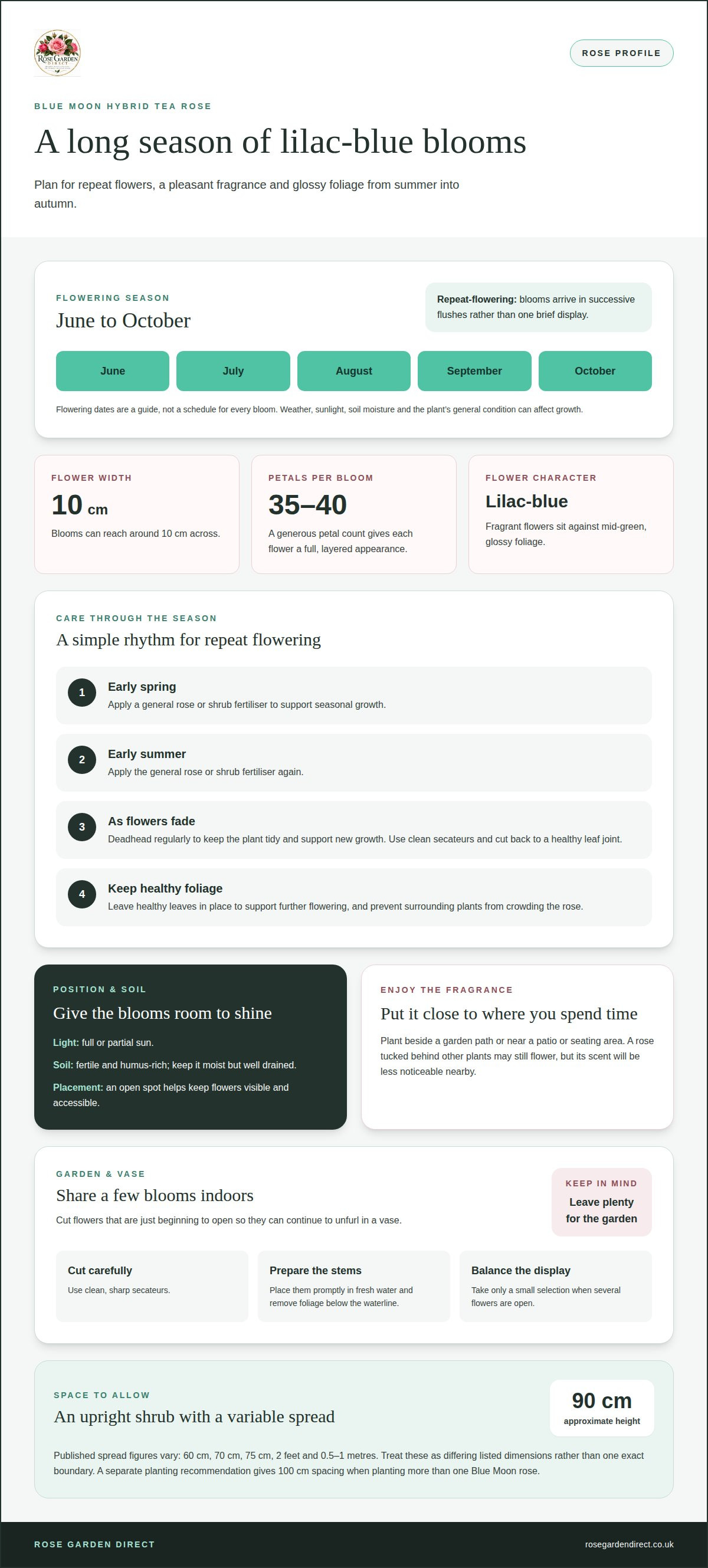
The Blue Moon hybrid tea rose has lilac-blue petals and a pleasant fragrance. Its scent complements the unusual flower colour. The flowers are described as fragrant, with a pleasant perfume, so you can enjoy them without needing to identify particular scent notes. For a closer experience, plant the rose where you regularly pass or sit, such as beside a garden path or near a patio. A shrub tucked behind other plants can still flower, but its fragrance will be less noticeable from nearby.
Flower form adds to the overall effect. Each bloom can reach 10 cm across and carries around 35-40 petals. That gives the flowers a full, layered appearance, rather than a simple open shape. The lilac-blue colour is most noticeable on the petals, whilst the generous petal count gives each bloom visual weight. Look at the plant as a whole when choosing a position: its flowers combine colour, form and fragrance, so they can be enjoyed both close up and across a border.
Blue Moon is repeat-flowering, with blooms from June to October, so its fragrance can be enjoyed beyond a single flush. Deadhead spent flowers to keep the display tidy and encourage new growth. Flowering can vary with growing conditions, but this period gives you a useful guide for planning seasonal colour in the garden.
For steady growth, plant in full sun and choose fertile, humus-rich soil that stays moist but drains well. Apply a general rose or shrub fertiliser in early spring and again in early summer. These practical care steps support the plant, but do not guarantee a stronger scent. Planting near a seating area makes it easier to enjoy the blooms during the summer-to-autumn flowering season. Avoid crowding the shrub with nearby plants, so its flowers remain visible and accessible.
Mature height and spread
Plan for an upright shrub reaching about 90 cm tall. Its listed spread varies, so allow practical room around the plant.
Mature plant height
The Blue Moon hybrid tea rose grows to around 90 cm in height. This gives it a clear place in a border without the scale of a climbing rose. Check the height when deciding whether to position it towards the front or middle of a planting bed. Nearby plants and the view from paths or windows also affect placement.
Use 90 cm as a guide to the mature plant, not the size of a newly planted rose. Before spring planting, compare that height with surrounding plants at their expected mature size. A tall neighbour can obscure the rose, whilst a more open position makes its upright growth easier to see. Leave room to reach the shrub for routine pruning.
Mature plant spread
Published descriptions give several spread figures: 60 cm, 70 cm, 75 cm, 2 feet, and 0.5-1 metres. These are different listed dimensions, rather than one consistent measurement. Use them to understand the likely footprint, and avoid treating the smallest figure as a precise boundary for every garden.
A separate planting recommendation gives 100 cm spacing for Blue Moon roses. If planting more than one, use that as a practical starting point when laying out the bed. For a single shrub, mark the intended area before planting and consider how neighbouring plants may fill out around it.
Measure both the available height and width, rather than judging the space from the young plant alone. A rose planted close to a path or another shrub may need more careful positioning as it matures. Keep the site accessible for pruning and leave enough room for the upright growth to remain visible. For help comparing plant forms, see these rose planting options.
Flowering season
Expect the main display from June to October, spanning summer and autumn. The rose can flower in repeated flushes rather than finishing after one brief show, giving it a place in the garden across several parts of the growing season. Mid-green, glossy foliage provides a leafy backdrop between blooms. Choose a position where you can see the flowers from a path, seating area or frequently used room.
For a longer garden display, remove spent flowers as they fade. This keeps the plant tidy and supports its repeat-flowering habit. Check the stems regularly during the season, especially after a flush has finished. Use clean secateurs to remove faded blooms, cutting back to a healthy leaf joint. Leave healthy foliage in place to support further flowering.
Flowering dates are a guide, not a schedule for every bloom. Weather, sunlight, soil moisture and the plant’s general condition all affect growth. Choose a sunny position and keep the soil moist but well drained. Apply a general rose or shrub fertiliser in early spring and early summer to support seasonal growth. As the rose grows through summer, prevent surrounding plants from crowding it.
You can also cut flowers for an indoor display. Choose blooms that are just beginning to open, rather than fully open flowers, so they can continue to unfurl in a vase. Use clean, sharp secateurs and place the stems in fresh water promptly. Remove any foliage that would sit below the waterline. Cutting a few stems brings flowers indoors while leaving others on the shrub for the garden display.
Plan indoor cutting around the outdoor display. Take only a small selection when several flowers are open, leaving plenty for the border. As autumn approaches, let the remaining flowers finish naturally. This balances vase use with the later-season display, while the glossy foliage gives the shrub structure between flowering flushes.
Blue Moon hybrid tea rose characteristics
Plant this rose in full or partial sun, in fertile, humus-rich soil that stays moist but drains well. Its hybrid tea growth and UK hardiness make the site and seasonal care important factors to consider.
Planting conditions and soil
Choose an open position with good light and soil that holds moisture without becoming waterlogged. Blue Moon can grow in chalk, clay, loam or sandy soil, with acid, neutral or alkaline pH. Improve the planting area with well-rotted organic matter if the soil needs more humus. The rose is rated H6, with a minimum temperature range of -20 to -15°C.
A two-year-old bare-root rose is supplied for planting during its dormant season. Set it in prepared ground and water it in, keeping the surrounding soil from drying out as it establishes. In a small garden, check drainage and sunlight before choosing a position. These conditions matter more than matching the soil to a particular texture or pH.
Pruning and care
Prune from mid-March, adjusting the timing for frost. Remove dead wood and unwanted growth with clean secateurs, making cuts at a 45-degree angle. Blue Moon belongs to pruning group 15, which covers hybrid tea and floribunda roses. Keep the shrub’s upright framework open, and remove damaged stems so the remaining growth has room to develop.
Apply a general rose or shrub fertiliser in early spring and again in early summer. A winter mulch of well-rotted organic matter helps protect the rose and enrich the soil. Keep mulch from touching the stems. These steps support healthy seasonal growth while maintaining the plant’s basic requirements for light and free-draining ground.
Tantau bred this hybrid tea rose in 1964. Its mid-green, glossy foliage gives the shrub structure between flowering periods, whilst its H6 rating suits gardens across the UK. For a practical next step, choose the Blue Moon bareroot rose for dormant-season planting.
Rose Garden Direct: Black Baccara Bareroot Rose
Rose Garden Direct offers the Black Baccara Bareroot Rose and the Blue Moon Hybrid Tea Bareroot Rose for your planting plans. If you’ve chosen Blue Moon, its bare-root form suits planting during the dormant season, typically in winter or early spring when there is little frost.
The choice is straightforward: select Blue Moon for its lilac-blue flowers and repeat flowering, or consider Black Baccara for a different rose in the garden. Rose Garden Direct also offers The Apricot Queen Elizabeth Bareroot Rose and the Dryopteris Male Fern 5L Potted Big Trunk.
For details, visit Rose Garden Direct.
Plan the planting spot before you choose
Before planting, observe how sunlight moves across the garden and note where rainwater collects. Check the space around your chosen spot, including room to reach the rose for pruning. A simple sketch can help you compare possible positions and clarify your planting plan.
Think about how you’ll use the space. This upright rose can be a feature near a path or seating area, while a border position suits planting it among other plants. Match the plant form to your timing: bare-root roses suit dormant-season planting, while a potted rose offers more flexibility. Weigh these practical details before choosing a position.
Rose Garden Direct offers the Blue Moon Hybrid Tea Bareroot Rose. If you’re ready to choose a plant for your garden, contact Rose Garden Direct today. Planning the position first gives your new rose a place that suits your garden and planting plans.
Frequently Asked Questions
Potted or Bareroot?
Choose potted for flexible planting dates, or bare-root for a dormant-season planting. Before planting bare roots, soak them in water for an hour to 24 hours. Roses supplied between November and February can be kept in their supplied packaging for 2-3 weeks. This can help if the ground is temporarily unsuitable, but plant promptly once conditions allow.
What is this hybrid tea rose and what are its characteristics?
It’s a hybrid tea rose, also known as a large-flowered bush rose. The plant can take 2-5 years to reach maturity, so allow time for it to develop. For home propagation, options include hardwood cuttings in autumn, softwood cuttings under glass in spring or summer, and chip budding in summer.
What colour and fragrance does Blue Moon rose have?
The petals are lilac-blue, and the flowers have a pleasant fragrance. If scent matters to you, consider how you’ll enjoy it from nearby paths or seating, rather than choosing a position based on colour alone. Avoid placing the rose where surrounding plants will block access to its flowers.
How tall and wide does the rose grow?
Plan for a mature height of around 90 cm, with spread estimates ranging from 60 cm to 1 metre. The spread figures differ, so avoid setting the plant tightly between fixed edges. Measure the available ground before planting and leave room for the shrub to grow outwards, rather than relying on its initial size.
When does it flower in the UK, and is it repeat-flowering?
It repeat-flowers from June to October, with blooms continuing through summer and into autumn. A bare-root rose planted at the end of the season in March may take up to 8 weeks longer to establish and flower. Keep that timing in mind if you’re planning a particular display for its first growing season.
How hardy and disease-resistant is the rose in the UK?
Its H6 rating indicates hardiness in the UK and northern Europe, with a minimum temperature range of -20 to -15°C. That rating describes cold tolerance; it doesn’t establish disease resistance. For day-to-day care, inspect the plant as it grows and remove dead or damaged stems during pruning, rather than treating hardiness as protection from other problems.


